



Hino P2635 Fault Code: Supply Pump Low Flow/Performance




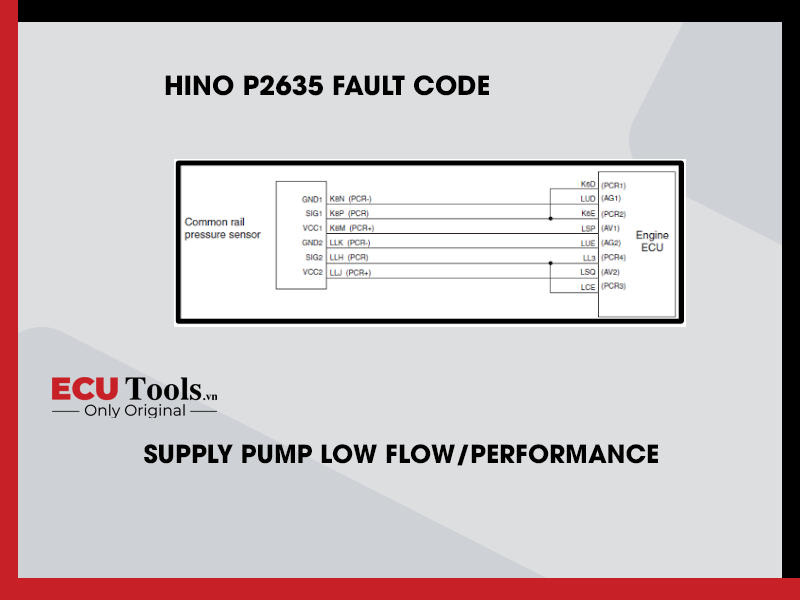
TECHNICAL DESCRIPTION
Excessively high common rail pressure (this duration varies depending on the engine speed) is detected.
DESCRIPTION OF MALFUNCTION
Supply pump was exposed to abnormally high pressure.
DTC SET CONDITION
DTC Detection Condition:
− Battery voltage is in the range of 10 V to 16 V.
− Common rail pressure sensor; no malfunction.
Judgment Criteria:
− Common rail pressure ≥ threshold map.
− 60 sec continue

RESET CONDITION
After normal operation is restored and the starter switch is on the “LOCK” position.
INDICATION, WARNING OR SYSTEM CONTROL REGULATION WHEN THE DTC IS SET
− MIL: OFF
− SVS light: OFF
PRE-INSPECTION WORK
Check that the battery voltage is in the normal range.
AFTER-INSPECTION WORK
− Clear all past DTCs.
− Check that no DTC is detected after test drive.
POSSIBLE CAUSES
− Supply pump failure.
− Malfunction of engine ECU.
INSPECTION PROCEDURE
TROUBLESHOOTING STEPS
Step 1) Inspect the start of the engine.
Inspect the start of the engine.
Did the engine start?
| Yes – Go to Step 4. | No – Go to Step 2. |
Step 2) Inspect the supply pump.
Check if fuel is leaking or seeping out of the supply pump.

Were any failures found?
| Yes – Replace the supply pump and go to Step 4 after replacement. | No – Go to Step 3. |
Step 3) Function check of supply pump [Diagnostic Tool].
- Connect the vehicle to the diagnostic tool.
- Set the starter switch to the “ON” position.
- Select [Engine].
- Select [Actual common rail pressure] and [Target common rail pressure] in [Data monitor setting].
- Start the engine while checking the common rail pressure
NOTE: Turn the starter switch OFF and ON verifies the wiping operation of the VNT actuator (DC motor).
| MEASUREMENT CONDITIONS |
| Starter switch: LOCK → ON |

Were any failures found?
| Yes – Replace the supply pump, go to Step 4 after replacement. | No – Contact the diagnostic tool OME. |
Step 4) Check the engine ECU.
Check the engine ECU software part number (ECU part number) by the diagnostic tool. Confirm the latest part number with the OEM.
Does the engine ECU have the latest software number?
| Yes – Go to Step 5. | No – Reprogram the engine ECU by using the diagnostic tool and then go to Step 5. |
Step 5) Inspect the pre-fuel filter.
- Check the pre-fuel filter.
− Has the replacement period expired?
− Is it dirty, damaged, or clogged?
− Is it a genuine OEM part?
- Check if the fuel inside the pre-fuel filter is within the standard value.
| MEASUREMENT CONDITIONS | STANDARD VALUES |
| While engine is running | At least 25.4 mm {1 in.} above collar and below the element upper level. Fuel level does not continue to drop during wide open throttle. |

Were any failures found?
| Yes – Replace the fuel filter element and go to Step 6. | No – Go to Step 11. |
Step 6) Inspect the fuel pipe and hose.
- Check if the fuel pipe and hose between the fuel tank and fuel filter are clogged, punctured, or bent.
- Make sure the fuel pipe joint bolts are not loose.
Were any failures found?
| Yes – Repair or replace the faulty part and go to Step 7. | No – Go to Step 7. |
Step 7) Inspect the fuel tank breather.
- Check if the breather hose is clogged, punctured, or bent.
- Make sure the check valve is functioning normally.
Were any failures found?
| Yes – Repair or replace the faulty part and go to Step 8. | No – Go to Step 8. |
Step 8) Inspect the fuel tank feed pipe.
Make sure the fuel tank feed pipe is not clogged.
Were any failures found?
| Yes – Repair or replace the faulty part and go to Step 9. | No – Go to Step 9. |
Step 9) Inspect the fuel tank.
Drain fuel out of the fuel tank and check if there are foreign objects inside the tank.
Were any failures found?
| Yes – Remove the foreign object and clean the fuel tank, then go to Step 10. | No – Go to Step 10. |
Step 10) Inspect the supply pump gauze filter.
Make sure the gauze filter (built into the supply pump) is not clogged.
Were any failures found?
| Yes – Clean the gauze filter and go to Step 11. | No – Go to Step 11. |
Step 11) Inspect the fuel high-pressure pipe.
Make sure the fuel high-pressure pipe is not leaking fuel.
Were any failures found?
| Yes – Repair or replace the faulty part and go to Step 12. | No – Go to Step 12. |
Step 12) Inspect the fuel filter.
Make sure the fuel filter is not clogged.
Were any failures found?
| Yes – Repair or replace the faulty part and go to Step 13. | No – Go to Step 13. |
Step 13) Inspect the SCV connector.
Check the connection of the SCV connector (Looseness or short-circuit).
Were any failures found?
| Yes – Repair or replace the faulty part and go to Step 14. | No – Go to Step 14. |
Step 14) Inspect the common rail pressure sensor connector.
Check the connection of the common rail pressure sensor connector (Looseness or poor contact).
Were any failures found?
| Yes – Repair or replace the faulty part and go to Step 15. | No – Go to Step 15. |
Step 15) Inspect the common rail pressure sensor power supply.
- Disconnect the connector of the common rail pressure sensor.
- Set the starter switch to the “ON” position.
- Use the electrical tester to measure the voltage between the terminals of the common rail pressure sensor vehicle-side connector.
| MEASUREMENT CONDITIONS | TESTER CONNECTIONS | STANDARD VALUES |
| Starter switch: ON | Common rail pressure sensor vehicle-side connector
VCC1 – GND1 VCC2 – GND2 |
4.5 – 5.5 V |

Do the measurements meet the standard value?
| Yes – Go to Step 16. | No – Repair the common rail pressure sensor and then go to Step 16. |
Step 16) Inspect the crankshaft position sensor (engine speed main sensor) [Diagnostic Tool].
- Set the starter switch to the “ON” position.
- Select [Engine].
- Select [NE sensor active flag], [G sensor active flag] in [Data monitor setting].
- Start the engine and confirm that the engine main speed sensor (NE) and sub speed sensor (G) operate (stay ON) continuously.
Were any failures found?
| Yes – Check the faulty sensor and repair or replace if as needed. After inspection, go to Step 17. | No – Go to Step 17. |
Step 17) Inspect the fuel return pipe and hose.
Check if the fuel return pipe and hose are clogged
Were any failures found?
| Yes – Repair or replace the faulty part. Clear all past DTCs. Check that no DTC is detected after test drive. | No – Procedure completed. Clear all past DTCs. Check that no DTC is detected after test drive. |
Whatsapp: +84.899.402.402
Facebook: ECUTools.vn
Youtube: ECUToolsvn
Tiktok: ECUTools
Website: ECUTools.vn
RELATED NEWS
See all