



Hino P20E8 Fault Code: Suction line pressure build up check




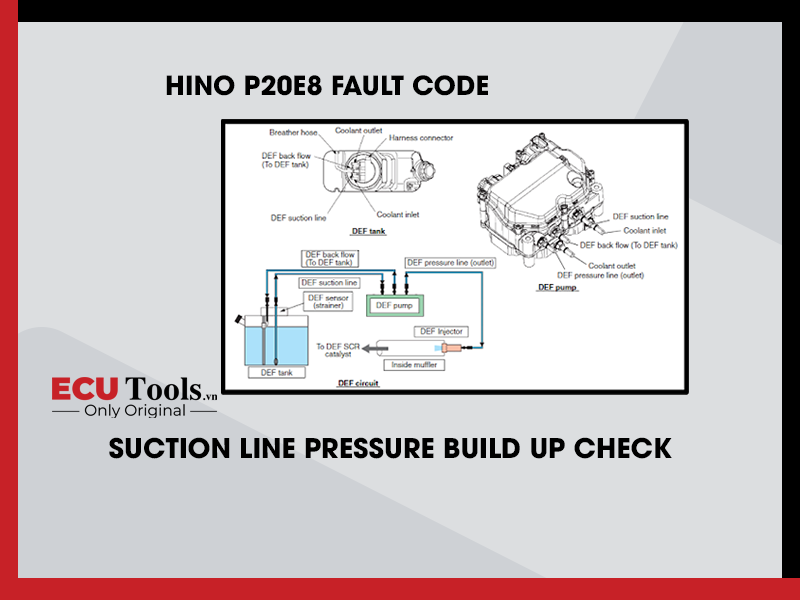

TECHNICAL DESCRIPTION
- DEF line pressure depends on ejection of the DEF pump.
- DEF pump ejection is determined by value of DEF pressure sensor which is built in DEF pump.
DESCRIPTION OF MALFUNCTION
- Abnormal pressure in the DEF pipe is detected.
DTC SET CONDITION
DTC Detection Condition:
- Exhaust gas temperature (SCR inlet) > 150°C {302°F}
- DEF defrosting is done.
Judgment Criteria:
DEF pressure does not rise to 650 kPa {94 psi} or more for approx. 6 minutes during “Pressure Build Up Mode”.
RESET CONDITION
After having restored to the normal conditions.
INDICATION, WARNING OR SYSTEM CONTROL REGULATION WHEN THE DTC IS SET
- MIL: ON
- SCR malfunction light: ON
- DEF injection is stopped.
- NOx reduction quantity monitoring is aborted.
- If malfunction does not improve within 500 miles: engine output is restricted.
- If malfunction does not improve within 2,000 miles: vehicle speed is restricted
SYMPTOMS ON THE VEHICLE WHEN THE DTC IS SET
Symptoms on the Vehicle Due to Backup Control (Fail Safe Function):
- NOx reduction function is prevented.
- Engine output is insufficient (when malfunction does not improve within 500 miles).
- Vehicle does not speed up (when malfunction does not improve within 2,000 miles).
PRE-INSPECTION WORK
- Check if the battery voltage is in the normal range.
AFTER-INSPECTION WORK
- Clear all past DTCs.
- Reset “Urea SCR related memory”.
- Check if no DTC is stored after test drive.
POSSIBLE CAUSES
- DEF in the DEF tank is empty.
- Strainer in the DEF sensor is clogged.
- Air is entering into DEF suction line.
- DEF suction line is clogged (frozen), or DEF leaks from DEF suction line.
- DEF pump main filter element is clogged.
- DEF pump inlet connector filter is clogged.
- Leak from DEF pump.
- DEF pump malfunction.
- Clogged DEF tank breather hose
NOTE:
- DEF-SCR system can be damaged by Diesel filling up to the tank.
- If DEF pump main filter has a yellow slime, it is an evidence of biodiesel filled to the tank.
INSPECTION PROCEDURE
TROUBLESHOOTING STEPS
Step 1) Inspect the DEF quantity, Check the DTC history.
- Connect the vehicle to the diagnostic tool.
- Set the starter switch to the “ON” position.
- Select [Engine] and check if P203F has been detected.
- Check the DEF quantity in the DEF tank visually.
NOTE: P203F is detected when remaining DEF level in the DEF tank is less than 5%. Has DTC P203F been detected? Is the DEF tank empty?
| Yes – Refill the DEF. The unit can be released after DEF tank breather hose cleaning. Clear all past DTCs. Reset “Urea SCR related memory”. Check if no DTC is stored after test drive. | No – Go to Step 2. |
Step 2) Check DEF leaks from the filter cap.
Check the tightening torque of the DEF pump filter cap. (Check for the DEF leakage or crystallization from the DEF tank filter cap.)
Tightening Torque: 20 – 25 N·m {204 – 255 kgf·cm, 15 – 18 lbf·ft}

Was the filter cap tightened correctly with the correct torque?
| Yes – The cap is tightened to the correct torque and no DEF leaks. Go to Step 3. | No – Tighten the filter cap with specified torque. The unit can be released after DEF tank breather hose cleaning. Clear all past DTCs. Reset “Urea SCR related memory”. Check if no DTC is stored after test drive. |
Step 3) Inspect the DEF pump electrical connector.
Check DEF pump electrical connectors visually 
Was any failure found?
| Yes – Repair or replace the connectors. If the connector corroded, replace both DEF pump and wire harness. The unit can be released after DEF tank breather hose cleaning. Clear all past DTCs. Reset “Urea SCR related memory”. Check if no DTC is stored after test drive. | No – Go to Step 4. |
Step 4) Inspect the DEF line between DEF tank and pump.
- Check all connectors and DEF hoses between DEF tank and DEF pump and check if they are free of leaks and DEF crystals.
- Gently pull on connectors and make sure they are securely connected:
- DEF hose connector (DEF pump side)
- DEF hose (suction side)
NOTE: If DEF leaks, deposits of DEF crystals will form around the muffler 
Were DEF leaks found?
| Yes – Replace the DEF line (connector and hose) between DEF tank and pump. The unit can be released after DEF tank breather hose cleaning. Clear all past DTCs. Reset “Urea SCR related memory”. Check if no DTC is stored after test drive. | No – Go to Step 5. |
Step 5) Inspect the DEF line between DEF tank and pump.
- Check condition of the O-ring inside the DEF connector.
(No crack on O-ring, No contaminant on sealing surface.) 
Was any failure found?
| Yes – Replace the DEF line (connector and hose) between DEF tank and pump. The unit can be released after DEF tank breather hose cleaning. Clear all past DTCs. Reset “Urea SCR related memory”. Check if no DTC is stored after test drive. | No – Go to Step 6. |
Step 6) Inspect the inside of DEF tank and DEF pick-up unit (DEF sensor).
- Remove the DEF tank from the vehicle.
- Remove the DEF pick-up assembly (DEF sensor) from the DEF tank.
- Drain the DEF from the DEF tank and check if large debris which can cover DEF suction area are found or fibrous debris are found in the DEF tank, strainer of DEF pick-up unit (in the DEF sensor) or drained DEF.

Was any failure found?
| Yes – Replace DEF, DEF pump inlet connector, DEF pick-up unit (DEF sensor) and DEF line between DEF tank and pump. Remove the foreign objects and clean the DEF tank. NOTE: The DEF tank must be cleaned with fresh water or diluted DEF. The unit can be released after DEF tank breather hose cleaning. Clear all past DTCs. Reset “Urea SCR related memory”. Check if no DTC is stored after test drive. | No – Go to Step 7. |
Step 7) DEF pump opening check [Diagnostic Tool].
Replace the DEF pump inlet connector and check the DEF pressure.
NOTE: If the inlet connector is clogged with debris, the debris will be moved to the strainer side by the after-run process. Therefore, use the following procedure to replace the inlet connector so that an after-run is not executed.
- Set the starter switch to the “LOCK” position.
- Connect the vehicle to the diagnostic tool.
- Set the starter switch to the “ON” position.
- Select [DCU].
- Perform [Leak test] for 3 minutes from the [DEF solution addition test] in [Inspection Menu] on the diagnostic tool.
Inspection Procedure:
- Select [Inspection Menu].
- Select [DEF solution addition test].
- Click [Start inspection] and then [leak test].
NOTE: Make sure to confirm no frozen DEF within DEF tank, pump and line prior this test. Otherwise, DEF pump may be damaged.
- Close the diagnostic tool.
- Disconnect the electrical connector from the DEF pump (with starter switch ON position) and wrap the disconnected connector by the plastic bag for prevention of water/DEF entering.
- Set the starter switch to the “LOCK” position and wait for 1 minute.
- Disconnect the electrical connector from the DCU and wrap the disconnected connector by the plastic bag for prevention of water/DEF entering.
- Disconnect the DEF suction line from inlet connector of the DEF pump.
- Replace the inlet connector of the DEF pump to new one (Oil the O-ring with Mobil velocite oil No. 6 or equivalent).
Tightening Torque for Connector: 4.0 – 5.0 N·m {41 – 51 kgf·cm, 3.0 – 3.6 lbf·ft}
- Connect the DEF suction line to inlet connector of the DEF pump.
- Connect the electrical connector to the DCU and the DEF pump.
- Set the starter switch to the “ON” position and conduct the DEF pump leak test with the diagnostic tool again. And read the DEF pump pressure on the diagnostic tool screen.
NOTE: Why DEF inlet connector should be replaced? DEF inlet connector has a filter, and intermittently DEF pressure won’t build up can be made by contaminated DEF inlet connector. Normal DEF pressure occasionally happened although there is 90% of restriction in the filter.
NOTES:
- DEF pump is a precision instruments, and at the replacement of the connector, clean around it to prevent mixing foreign objects, and work in the clean environment where the cloud of dust, etc. does not swirled as possible as you can.
- Do not use textile gloves (example: work gloves) at working to prevent the foreign objects to adhere.
- As DEF is highly corrosive, take care that it does not get onto surrounding parts. Special care is required as this may cause a malfunction, particularly when DEF comes in contact with electric wiring or connectors. If DEF gets onto a component, wipe it off immediately, using a rag moistened with hot water; if necessary, rinse it off with hot water, and then dry completely. Before connector installation, check visually and make sure that no signs of corrosion etc. are present.
| MEASUREMENT CONDITIONS | STANDARD VALUES |
| Starter switch: LOCK | The DEF pressure is stable in the 850 to 950 kPa (123.3 to 137.8 psi) range for 60 seconds. |

Do the measurements meet the standard value?
| Yes – The cause is clogged DEF inlet connector. The unit can be released after DEF tank breather hose cleaning. Clear all past DTCs. Reset “Urea SCR related memory”. Check if no DTC is stored after test drive. | No – Go to Step 8. |
Step 8) Inspect the DEF suction line [Diagnostic Tool].
- Set the starter switch to the “LOCK” position.
- Disconnect the DEF suction line between the DEF tank (1) and the DEF pump (2) and connect the SST. − SST: HOSE SUB-ASSY, UREA (S0920-E0020)
- Connect the vehicle to the diagnostic tool.
- Set the starter switch to the “ON” position.
- Select [DCU].
- Perform [Leak test] from the [DEF solution addition test]. Read the DEF pump pressure on the diagnostic tool screen.
Inspection Procedure:
- Select [Inspection Menu].
- Select [DEF solution addition test].
- Click [Start inspection] and then [leak test].
| MEASUREMENT CONDITIONS | STANDARD VALUES |
| Starter switch: LOCK | The DEF pressure is stable in the 850 to 950 kPa (123.3 to 137.8 psi) range for 60 seconds. |

Do the measurements meet the standard value?
| Yes – The cause is clogged DEF suction line. Replace DEF suction line. The unit can be released after DEF tank breather hose cleaning. Clear all past DTCs. Reset “Urea SCR related memory”. Check if no DTC is stored after test drive. | No – Go to Step 9. |
Step 9) Inspect the DEF pick-up unit (DEF sensor).
- Set the starter switch to the “LOCK” position.
- Fill a clean small container with clean DEF.
- Disconnect the SST DEF tank-side connector (1) and put the connector into the container containing the DEF.
- Set the starter switch to the “ON” position.
- Perform the [Leak test]. Read the DEF pump pressure on the diagnostic tool screen.
| MEASUREMENT CONDITIONS | STANDARD VALUES |
| Starter switch: LOCK | The DEF pressure is stable in the 850 to 950 kPa (123.3 to 137.8 psi) range for 60 seconds. |

Do the measurements meet the standard value?
| Yes – The cause is clogged DEF pick-up unit (DEF sensor). Replace DEF sensor. The unit can be released after DEF tank breather hose cleaning. Clear all past DTCs. Reset “Urea SCR related memory”. Check if no DTC is stored after test drive. | No – Replace DEF pump. The unit can be released after DEF tank breather hose cleaning. Clear all past DTCs. Reset “Urea SCR related memory”. Check if no DTC is stored after test drive |
Whatsapp: +84.899.402.402
Facebook: ECUTools.vn
Youtube: ECUToolsvn
Tiktok: ECUTools
Website: ECUTools.vn
RELATED NEWS
See all